Realistic Pantry Organization That Survives Past Month One
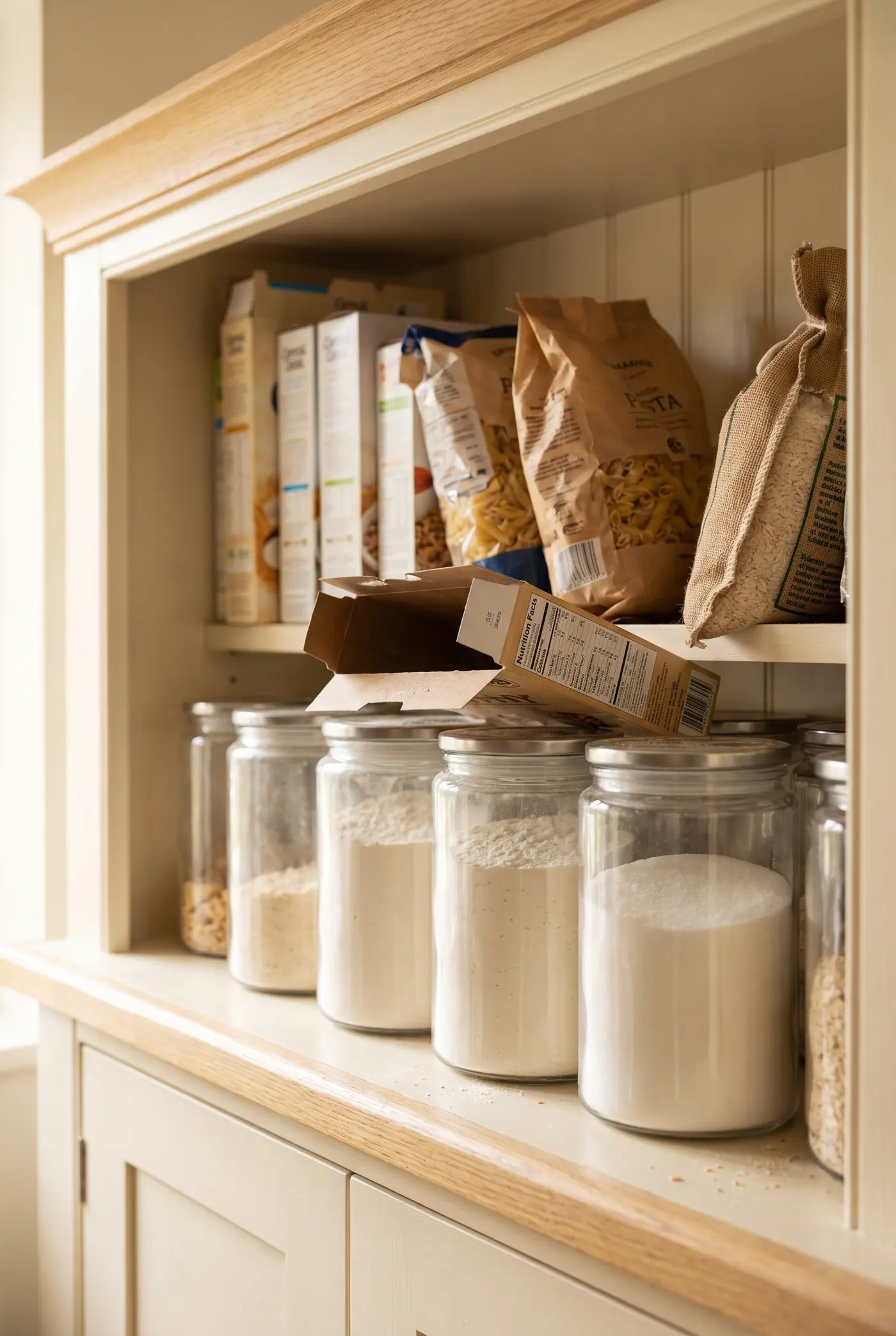
Search pantry organization and you get photographs of forty matching glass canisters, hand-lettered labels, and not a single cardboard box. Those pantries are styled for a photograph. They are also, in most cases, actively worse to live with.
Here is what a pantry that stays organized for more than a month actually looks like.
Looking for the products rather than the method? Pantry Storage Containers Worth Buying, And How Many
Decant selectively, not completely
Transferring everything into matching containers is the most common advice and the most common reason people give up.
Decanting genuinely helps for three things: items that come in bags that will not stand up, items you buy in bulk, and items where you need to see the level at a glance. Flour, rice, pasta, cereal, sugar, pet food.
It actively hurts for everything else. Canned goods are already stackable and labeled. Boxed items have cooking instructions printed on the box that you will need and will no longer have. Anything you buy once a year does not justify a container.
A realistic pantry is maybe six to ten decanted items, not forty.
Sort by when you reach for it
Category sorting looks tidy and fails in practice, because it puts the daily coffee on the same shelf as the once-a-year cake decorating supplies.
Sort by frequency instead:
- Eye level: daily and near-daily. Coffee, cereal, snacks, the oil you cook with
- Below eye level: weekly. Pasta, rice, canned goods, baking staples
- Top shelf and floor: bulk backstock, seasonal, appliances you use twice a year
This is free, takes twenty minutes, and does more than any container purchase.
Give things edges
The reason pantries decay is that items have nowhere to stop. Without edges, everything drifts forward, sideways and into a single undifferentiated mass by week three.
Bins, baskets and shelf dividers work not because they are attractive but because they create boundaries. When the snack bin is full, you know it is full. When there is no bin, you just push things back.
Shallow open bins beat deep closed ones for anything used weekly. You want to see the contents from the doorway.
Expiry lives at the front
The single most useful pantry habit costs nothing: when you unpack groceries, put new items behind the old ones. Front to back rotation is how supermarkets do it and it is the entire reason you rarely find expired stock in a store.
Without this, you buy a second jar of something you already have and the first one expires behind it.
Labels, honestly
Labels help when more than one person uses the pantry, or when decanted contents are ambiguous — three white powders in identical jars is a real problem. They do very little in a single-person pantry where you decanted the items yourself last week.
If you label, write the expiry date on it too. That is the information you will actually want and cannot recover once the box is gone.
What good looks like
A pantry that works is not photogenic. It has a few decanted staples, several labeled bins with boundaries, boxes in their original packaging, the daily items at eye level, and about fifteen percent empty space so there is somewhere for groceries to go.
If yours looks like that, it is done. Do not let a photograph tell you otherwise.